Thursday, 26 July 2012

Letters from Space Camp - 2


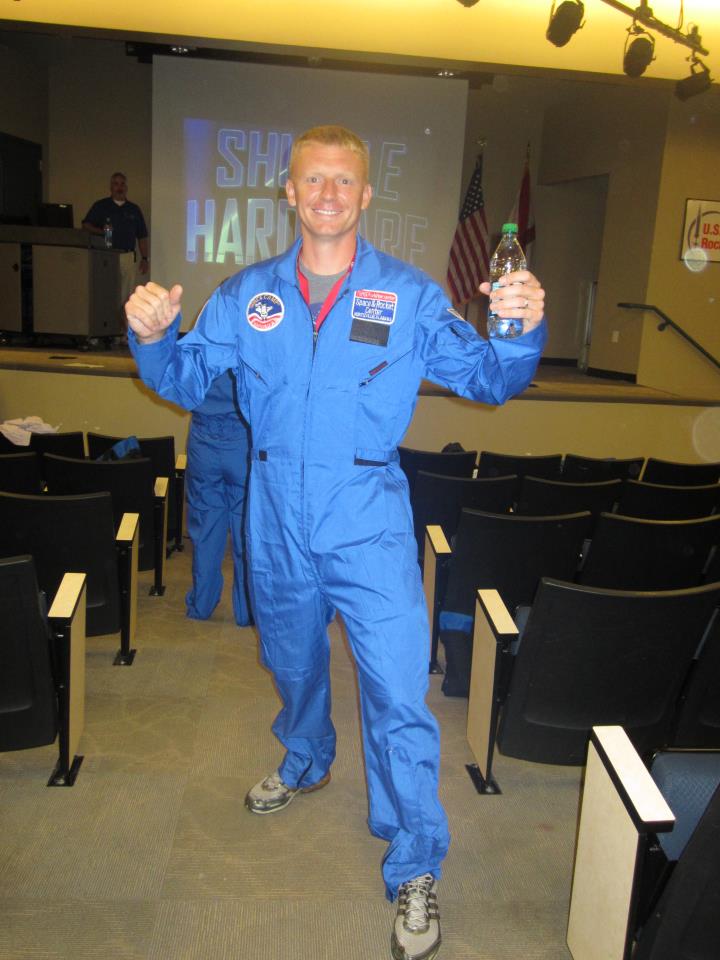
This week I have been privileged to do many things I never imagined I would actually do…especially as an adult. I walked on the moon, experienced temporary weightlessness, and performed a few deep space missions. Yet, one of my favorite moments of Space Camp was having the opportunity to listen to Ed Buckbee address our group. He gave us all a fantastic overview of NASA’s space program in the early years and specifically the “Real SpaceCowboys”. By the time he was done speaking I was ready to get back to school and inspire the next generation of much needed engineers, scientists, and leaders.

Buckbee told us a great many stories that we inspiring, amazing, humorous and just plain cool. The theme that came out the most in his stories was this notion of we were in this together. After JFK announced that we would be going to the moon, the entire country was behind this project. Even some of my fellow teachers who were living during this age remember the collective national passion behind the NASA programs in the early years. Everyone was behind the astronauts and the men that would eventually put them on the moon.

One of my favorite anecdotes Buckbee shared was when he talked about Wernher von Braun and how he would walk down the halls and tell people, “you are on the critical path”. He wanted everyone to know that they were part of something bigger than themselves. Everyone knew they were a part of the mission to put man into space regardless of what role they played. Another story was of Alan Shepard, one of the early astronauts, who was speaking to a technician working late at night on one of the launch rockets. Shepard asked the man if he knew how all the parts in the rocket worked. The man replied that he did not but said, “I’m gonna make my part work.” No one person knew how it all worked but they knew how to do their small part in making the whole work.

These men understood they were part of something much larger and greater then themselves. They were aware they played but a small role but each and every role served a purpose. The sheer complexity of putting a man in outer space is staggering when you think of the millions of pieces, parts and potential pitfalls and errors that were possible. However, all of these people were working together towards a common goal was powerful and the result was putting man in space.  

I was going to attempt to make a connection to the classroom but will save that for another post. Listening to the stories of the space program and what these pioneers did was inspiring to me as a teacher and as an American. It is sad to think that in my lifetime I have only ever seen our country come together behind a common goal in response to national tragedies.  I recognize it was another time period in American history but I hope to inspire my students to find something like these men did. I want them to be as passionate about something as the early men of NASA were. There is little doubt in my mind that when we are passionate about what we are doing and recognize our own roles amazing things can happen. 

Sunday, 22 July 2012

Letters from Space Camp - 1


This week I am coming to you live from Huntsville, Alabama where I am privileged to be attending International Space Camp. Last night was our “opening ceremonies” where the teachers of the year from every state introduced themselves and their state while wearing some sort of costume to represent their state. We had New York dressed as the Statue of Liberty and the guy from Washington as a nearly fully functioning Mount St. Helens and 48 other costumes. After each state introduced themselves and presented, we had the great pleasure to listen to our international counterparts speak about their countries which was both highly informative as well as entertaining. My favorite was the German students who presented a couple abridged versions of Brothers Grimm fairy tales in hilarious fashion.


Beyond the pomp and circumstance of the opening ceremony we have also had the opportunity to listen to Astronaut Charlie Duke. He spoke to our group about his experiences in NASA and his Apollo 16 flight and subsequent walk on the Moon. Needless to say there is something surreal listening to a man talk about walking on the moon in the same manner I talk about walking to the ice cream shop. In addition to Duke, we had dinner with other members of NASA’s space program including some of the original designers and engineers that worked on the Saturn 5 which was directly overhead as we ate.

Today we begin our flight missions and presumably the real “fun” of Space Camp that many children have dreamed of participating in. As I being this week full of learning, challenges and surely a great deal of fun, I am reflecting on a comment made in our first session when we arrived here at Camp. The coordinator of the program was introducing Space Camp and the ideals of NASA and overall space exploration. While doing so she said, “we explore because it’s there.”

She didn’t say we explore because we have to. Nor did she say we explore because we are being asked to. Yes, you can argue that the engineers and astronauts were doing their work because it was their job and they did have someone telling them to do just that. However, at the very basic level, the exploration of space was out of a sense of wonder and amazement and probably a heavy dose of curiosity. When you listen to the people involved in the early years of NASA as we have this weekend, they truly loved what they did. They wanted to put man into outer space and did just that. They were creative problem solvers and critical thinkers because they had to be. What is more amazing is just what they were able to accomplish with the level of technology they had available. As Duke said, we have more technological power within an iPhone that he did on the entire Apollo 16 ship. That is staggering.

I plan on using the phrase “we explore because it’s there” in my classroom. I want my student to explore and discover because it’s there, not because it will be on the test or because it is in the curriculum map. I want them to learn because it’s there…period. 

Wednesday, 18 July 2012

Does Twitter Matter?


Many people question the value of twitter and if it can really make an impact for an educator. After nearly two years as a user, I can say with little hesitation that twitter has impacted my life in ways both subtle and profound.

Impacted my students
Clearly anything that a teacher spends a significant amount of time engaging in and claiming it is “PD” should benefit the students, right? Well that is certainly true in my case. Due to connections I have made on twitter, my students have be able to make connections as well. They have engaged in the Collaboreyes Project as well as Skyped with classes in different parts of the country. That is not to say I could not do this without twitter, but twitter certainly made those connections easier to create and foster.

In addition, there have been countless times I have reached out to my PLN to help my students. I was able to have my students connect to experts while doing research as well as gain primary sources. Another huge benefit has been the innumerable resources I have been able to give my students through the sharing I have done on twitter.

Impacted my teaching
There has been numerous ways in which twitter has helped my teaching. Probably the simplest way is through the conversations I have been able to participate in. Some of the easiest to get involved in are the various chats that take place weekly and use a hashtag to follow. It was through these chats that I learned about the Hole in the Wall Theory that framed a research project and guided much of my teaching. I gained numerous resources for teaching Social Science with the help of the great folks at #SSCHAT. I have also been challenged about my beliefs on homework, grades and overall teaching beliefs on a regular basis that has helped shape what I think of as my own teacher identity.

Another specific thing I pulled from twitter was connecting with Daniel Pink and chatting with him about his work and book, Drive. His work and conversations sparked Innovation Day at our school that has gotten national attention. In addition, I was actually able to sit in Pink’s house and talk with him about education, business and how the two can intersect.

Impacted my life
The impact on my life goes far beyond just making me a better teacher and yet related. I firmly believe that the work I did this past year as a teacher was driven in large part to the learning I was doing on twitter. It is because of this renewed approach to teaching and the connections I made that lead to some of the recognition I received for my teaching this past year. As a result of these recognitions I have been able to meet the President, fulfill a lifelong dream and do things and meet people I never thought were possible. Some people might think twitter is trivial, but I can honestly say it has changed my life.

Impacted my family
The impact on my family is both negative and positive as one can imagine. I have had to work to provide balance in my twitter use so as not to neglect my roles as a parent and husband. This might seem silly, but it is something that must be put into perspective. However, the impact of my twitter “folks” was illustrated perfectly last month when I attended ISTE in San Diego. Prior to attending the conference my wife had hip surgery to repair damaged cartilage and some bone irregularities. Now the surgery was not that invasive but she was laid up and out of commission. Right before I was preparing to leave for ISTE the doctors found a blood clot in my wife’s leg during a follow up which was incredibly scary for both of us. I tweeted out something about it and within minutes I was flooded with well wishes and prayer notes. Now, this is to be expected as most people are human and this is something we do. Yet, what I didn’t expect was the number of people that sought me out in person in San Diego to see how my wife was doing out of genuine concern. Even today, several weeks later, I am still having folks tweet me to ask how my wife is doing. This is not the part of twitter that most people are seeking when they “join up” but it is a real aspect as personal connections are powerful and meaningful.

If you know someone that is not on twitter…harass them a little bit more to jump in the water. I am not going to say twitter is for everyone, but it is certainly for me as I get way more out of it that I originally bargained for. 

Friday, 6 July 2012

Building Within the Box


It has been a little bit more than a week since I returned home from the annual ISTE conference in San Diego. This will be the first of many reflective posts I write as I have many takeaways rattling around in my head. One of the highlights of the conference for me was listening to Sir Ken Robinson speak as part of the keynote and then as part of a Q and A follow up. Now, I won’t get into the horrible job other panelists did, but Sir Ken mentioned something that stuck with me during his Q and A.

At some point during the Q and A Sir Ken made a statement basically stating that teachers often have more freedom than they willingly exercise. Essentially, we complain about all the restrictions and “boxes” we are placed in but we don’t push the limits and see what we can actually do. In fact, he stated that teachers can actually do more innovative and new things within their current environments than they are often willing to try or think they can.


I spent a great deal of time reflecting on these statements and I think there is a great deal of truth within them. It is very easy to complain about poor leadership, bad policy, and the millions of other obstacles teachers face. I will be the first to tell you that I am certainly guilty of that more often than I should. It is always easy to complain about the metaphorical box we have been placed in without trying to do anything about it. There is often a great deal more that teachers can do than we give ourselves credit for. What is holding us back? Is it fear…fear of failure…fear of repercussions…fear of the unknown…

In thinking ahead to next school year, I want to make an effort to do less complaining about the box and start building, creating and innovating within whatever box my students and I find ourselves in. 

Tuesday, 26 June 2012

Expanding Student's Horizons

Recently, I had the distinct pleasure to model the new ISTE Ignite sessions at the kickoff session of the 2012 ISTE conference in San Diego. For those of you that don't know what an Ignite session is, it is a fast paced style of presenting. The speaker is given a set number of slides and a limited time on each slide. The presenter does not have control over the slides as they will change automatically when the time is up. For me, I had 15 slides and each slide was up for 15 seconds. It was a lot of fun and I can see this being a useful model even for students presenting in class.

Enjoy!

Monday, 25 June 2012

Being a 21st Century Teacher


Lots of people are tossing around terms in education and attaching the words “21st Century” to appear cutting edge or on the front end of trending ideas. As a teacher in the 21st century I find it amazing to see some of the things that are so called “21st Century” and yet are no different than 20th or even the 19th century ideas. With that in mind, I have reflected recently on my opinion of what it takes to be a teacher in the 21st Century and what exactly such a teacher would look like.

Obviously, a 21st century teacher should be tall, handsome and have a sweet spot for super heroes. Beyond that, I think there are some key characteristics that good 21st century teachers need.

Be a connected educator - The idea of being a connected educator is not necessarily new but is certainly transforming with the dawn of various technology tools in the area of social media. Teachers now have the ability to connect to other teachers, administrators, parents, students and other education minded people around the world with the click of a button. There are many tools out there that allow teachers to connect. Regardless of what you use, a good 21st century teacher must be connected. There is no right way to do this. For me, I use Twitter and my Blog to connect and learn from and with educators around the globe.

Be a master of technology – Now, I am not saying that a good 21st century teacher needs to have an interactive whiteboard hanging on their wall, tablets in every kid’s hand and mobile devices in every corner of the room. In fact, I think it might be more the opposite or at least a balance. In recent years educators have gone overboard with spending money and pumping technology into every corner of their schools they could possibly afford. The problem is they offered little training and much of it was used as a simple badge of honor to say they had tech in the building. Interactive whiteboards are being used as chalk boards once were, computers are being used to make flashcards and tablets are being used to do word searches. A good 21st century teacher knows the difference between what is shiny and new and what truly has the potential to transform learning for their students. A new hammer is great but a good carpenter doesn’t try to screw in a bolt with one. In the same way, a 21st century teacher knows what tools are needed and when and how to use them.

Be a reflective practitioner – This is probably one of the most important areas as we as a profession in many cases have not changed in 100 years. The tools in our classrooms have changes but the pedagogy and practice has not. A 21st century teacher is able to look at their own practice and adapt and change based on the needs of the learners. Too many teachers are teaching in the year 2012 as they did when they started their careers 10, 20 or even 30 years ago. What we know about student learning and motivation has changed, so too must the art of teaching. Stagnation is the death of any teacher.

Be an advocate – The final thing I feel is important for a good teacher in this century is to be an advocate for themselves as well as the profession. If we as teachers think someone else is going to say nice things about our profession and share positive notes on the 9 o’clock news, we are wrong. As teachers we can sit and complain about it…or we can do something about it and find ways to tell our own stories. It is a critical time in the history of education and how the profession in currently perceived in the public eye. We are under attack in many places and rather than playing the part of a wounded animal, we need to stand up for ourselves and advocate for the great work we do every single day.

None of these ideas are radical or ground breaking by any stretch. Yet, too many teachers are content wrapping up old practice with new gimmicks and wonder why we don’t get any better at what we do. If we want to gain respect as a profession then we must truly embrace a 21st century model of constant growth and improvement. If we don’t get any better we only have ourselves to blame.

Monday, 4 June 2012

Do We Really Need Principals? A Follow Up


A little while back I published a blog post questioning if we need principals in schools. In the days and weeks that followed I received a great deal of feedback on twitter, comments on the post and subsequent follow up blog posts others wrote in response. I have reflected at great length and still stand by my original question with a slight change…Do we need principals/administrators in the way we use them today?

Based on the feedback and my own reflection I do think we still need a leader in a building or at least a network of leaders in various roles. I think it could play out in a few ways but here are some initial thoughts on how we might change the current role of administrator to better suit the needs of schools and students. Yet, all of this is built upon the premise that a principal/administrator needs to be an instructional leader within their building.

·         Get them into a classroom – I am not referring to the fly-by drop in observations or the token waves from the hallway. I am talking about them actually teaching in a classroom…with kids. This could be done in a few different ways depending on level. If they are in a departmentalized environment, they could pick up one class to teach each term. In a primary level they could co-teach or pick up a section of a special. One of the biggest complaints I hear about administrators is their complete lack of connection with the classroom. Some have been out too long or have never really been “in” a classroom because they jumped up the ranks so fast. Teachers grumble at their decisions because they feel like they don’t know what they are talking about.
·         Term limits on administrators – This is a pretty simple concept but ties in nicely with the first point. Yes, there are some administrators that have been in the “front office” for many years and are still connected and in tune with the students and teachers. However, I think it is safe to say that is not the norm. Rather, the longer they are out, the more out of touch and distant they become as a natural consequence. I am not sure what the magic number is, but I would think having a five year limit and then being required to teach for two years before coming back might be a good place to start. Lyn Hilt also outlined a similar concept in a comment she left on a recent post by Jeff Delp.  Personally, I think this would elevate the instructional leadership potential within a building and have dramatic results.
·         Hire a manager – Much of what pulls an administrator away from being a true instructional leader in their building is the managerial items they get bogged down in. Why not hire an administrator who is simply in charge of the management piece? They do all the paperwork, scheduling, meetings, etc. Then dedicate one administrator to being a true instructional leader. As I mentioned in my previous post, I still think these two jobs could be done by a small group of teacher leaders as well. However, if we are going to work within the current system, then let’s shift some responsibilities around to best use our administrators.

It may be way to simplistic but if we want our administrators to be instructional leaders, which I think we do, then they can’t sit idly by in an office. I don’t see any better way of doing this than getting the metaphorical chalk back in hand and doing it in a classroom. As in my initial post, I still am not seeing a compelling argument for a need for administrators in their current roles. Yes, lots of people commented about them being a buffer and an advocate, but is that what we need administrators to be? If that’s the case then let’s call them managers and let the teachers do the instructional leading…

In closing, let’s be clear about one thing, I am not calling out all administrators and saying we need to get rid of them. However, I am calling out the way in which we as school districts use them within our schools. They have the potential to be so much more than paper chasers and disciplinarians. If you look at the great administrators you will rarely find them at a desk when the kids are in the building. Yet, they are burdened all night with paperwork and management items. In addition, if these are the individuals evaluating teacher effectiveness, how do we ensure they know that when they see it? How can we restructure this to allow all administrators that chance of being a true instructional leader?