Thursday, 20 September 2012

The Good, the Bad and the Ugly


Over the past year I have had the opportunity to do a great deal of speaking, presenting and collaborating with educators all over the country. In talking with educators from every state in the US as well as numerous of the US Territories, I have gained a unique perspective of the state of education in our country. Now, I am not going to pretend to be an expert but want to share some of the things I have seen, heard and experienced. Despite what the title suggests, I will go a bit out of order in my observations.

The Bad:
There are bad teachers teaching in our schools. I have seen them. I have talked to them and listened to them talk. I have heard more stories from other educators about these bad teachers than I would ever have time to share. They are out there in our schools teaching students every single day.

To be clear, I am not talking about the teachers whose students’ standardized test scores are low. Nor am I talking about the teachers who are labeled bad by some subjective administrator evaluation. I am talking about those teachers who are demeaning to children. The ones that teach the same way in year one as they do in year thirty one. Their lesson planner rolls over and the copyright dates in their packets are before the students were even born. Some are even engaging in inappropriate relationships with students or are abusive. These are the teachers that as parents we never want our children to have. They are out there and nearly every teacher or administrator I talked to could point out at least one in their building or district.

While this sounds bad, the reality is that these teachers are by far in the minority. They are few and far between but unfortunately they get all the press. These teachers end up on the 5 o-clock news for their antics and often embarrass our entire profession.

The Ugly:
As I have travelled and spoken to media, education lobbyists in Washington and even a handful of politicians and policy makers, I see lots of ugly. That is not a knock on these people’s personal grooming but more on the actions of the individuals within our government and our major media outlets. Despite what people want to believe, real change in our country’s educational system will only happen with a concentrated and real effort on the part of at least one of the two major influencers, media or government.

The national mediahas more power to change public perception and put pressure on politicians than any teacher’s union or grassroots movement in schools or on social media. Yet, they choose to report on the negative and continue to perpetuate the stereotypes that prohibit educators in our country from achieving a level of professional respect that many other professions are afforded. It is literally ugly at times to watch the education stories that show up on the news and in the papers. Media outlets are letting the few bad teachers tell the story for an entire profession.

Government is such an easy target these days in an election year where everyone is pointing fingers and casting stones. However, the reality is our state and national governments are doing little to help the state of education in our country. We have politicians around the country speaking of the importance of special programs and extracurricular activities in our student’s schools. Yet, when it comes down to voting and allocating resources, those are the first to get cut. There are policy makers that claim they don’t want teachers teaching to tests. Yet, they create systems of accountability that not only necessitate teaching to the tests but also set up a system built to encourage cheatingand not collaboration. It is ugly to see the amount of pontificating that happens with little actual action to support those words. As the old saying goes, “actions speak louder than words.”

In addition, fake political campaigns in an election year to artificially show respectfor teachers will not create any lasting change. Our politicians spend more time trying to get reelected and further polarizing the people of our country that any improvement or this so called “system” may be an unachievable dream.

The Good:
Of course I saved the best for last which is the good I have seen. Despite the bad teachers, disinterested media and incompetent policy makers, there is good abounding in education and it is everywhere. I could write for days about the stories I have heard from educators across the country and beyond. One such story is of Chad Miller, a teacher from Hawaii, who shared with me his school’s mission of promoting peace and a philosophical approach to learning. Then I was blown away when I learned that the Dalai Lamahimself visited Chad’s school to talk about his mission and the work of the teachers and students. The work that he and colleagues are doing along with their students is inspirational to say the least.

I am constantly amazed by the sheer number of teachers that share their very best work and that of their students through social media. They have no obligation to do so but still choose to share in an effort to better learning for all students. Spend an hour following a hashtag or a discussion thread and you will see powerful work happening in 140 characters every minute of every day.

In my heart I believe an overwhelming majority of educators are doing good work. They are working day in and day out to the very best of their abilities. They spend countless hours perfecting their craft and making the learning experiences in their classrooms the best they can be despite the lack of funding and professional respect.

The Verdict:
What does this all mean? What have I taken away from this? Well, it is actually quite simple to me. Celebrate the good, fight the bad, and acknowledge the ugly.

We must bring each other up in a genuine manner and celebrate the good around us. Send a note to a peer who is doing something positive or trying something new. Encourage the positive work that is happening in your schools in big and small ways. We cannot settle for mediocritynor should we tolerate it and need to fight against all forms of “bad” in our schools. We need to provide opportunities to support and improve teachers but also know when enough is enough. Cut our losses on those teachers who refuse to improve and focus on those that have a chance to be better. Acknowledge the ugly media campaigns and political circus but don’t spend our time focusing on things we really don’t have control over. Recognize and be informed but remain focused on what is important…the students. At the end of the day we must remember that above the tides of ugly and bad that can easily discourage our work as educators, there is far more good that we must recognize and appreciate. 

Wednesday, 12 September 2012

Passion Projects


I am always looking for ways to inspire my students and promote learning in my classroom. The biggest obstacle I often face is school itself. Whether its curriculum, rules, schedules, standardized tests or the host of other things that get in the way of inspired learning, there is always appears to be some obstacle. The past two years I have been fortunate to offer my students a day of unfiltered learning that was driven by their passions and interests in the form of Innovation Day. For me, it always kind of bothered me that this day only happened one time during the school year. I wanted a way to have this notion of learning exist in my classroom more regularly and this year I am giving something new a try.

Two weeks ago I introduced my students to something a colleague and I are calling “Passion Projects”. We committed a day a week (which is a class period in a junior high setting) to allow kids to work on these projects. To start, we asked our students what they were passionate about. What did they want to be when they grew up? If they had unrestricted time and resources to learn about something, what would that be? As a class we talked through the answers to these questions and started designing projects and learning activities based on their interests. Below is the first list of topics that was generated by my students during their first brainstorm.
  • Music
  • Environmental impacts on testing
  • Entertaining
  • Ocean
  • Building
  • Website design
  • Interior Decorating
  • Fishing
  • Photobooks/Photography
  • Acting
  • Writing
  • Engineering
  • Dinosaurs
  • Dancing ballerina
  • Cooking, chef
  • Perform-drama-skits
  • Occupational Therapy
  • Marine biology
  • Animals
  • Basketball
  • Swimming animals
  • Game design
  • Meteorology

Now some of these we are working with and creating into “doable” projects within the parameters of our school day and physical space. Outside of that, I have given them very few restrictions. One requirement I gave them is that I want them to keep a learning journal in some form to reflect on their learning. The other thing I asked them to do is share their work with their peers a few times over the course of the year. I told them I will provide feedback and guidance but never a grade or evaluation.

My goal is for students to pursue something they are passionate about and may never get a chance within a school to study. One way I hope to further inspire them is to use my social media “superpowers” to connect my students with some experts or professionals in some of the above topics. For example, I am already working on connecting my young meteorologist with one of the stars of Discovery’s show Stormchasers. I truly want to inspire these kids to think outside of the box and find something to be passionate about. If are or know somebody that is connected to one of these fields please leave me a comment as I would love to talk with you.

I look forward to sharing this journey with my students and sharing their successes and spectacular failures along the way. 

Tuesday, 4 September 2012

The Victim


The other day I had the opportunity to speak with a student who was heading back to school as so many children are or will be soon. This particular student, a young man, was not too keen on going back to school. I asked him why and he just said he hated school and didn’t want to go. Knowing this student fairly well, and even knowing a great deal about his school, I was a little taken back by this. Here was a good kid who I thought had a great previous school year, who was now nearly petrified of going back to school. I couldn’t for the life of me understand why. Personally, I just wrote this off to the unease that often accompanies a new school year. I even went as far as to talk to his mother about the situation and she was just as baffled as I was.

As any good parents would do, this young man’s parents encouraged him and slightly “forced” him on the bus that first day of school. Knowing both of them well, I knew the anxiety they felt and uncertainty of how his day would go. At the end of the day, he got off the bus, came home and appeared to be in good spirits. When he was asked about his day, he simply replied that it was good and that he wanted to go back the next day.

Being the inquisitive person that I am, I was curious as to what could have happened on the first day of school that could flip his seemingly strong feelings so quickly. Once I had a chance to sit down with him, I asked him how his first day was. He replied that it was good as he had told his mother. I then followed it up with the question, why? Why was school good for him? He looked at me and said, “Pat is not there anymore.”

Now, Pat is a fictional name because I don’t want to embarrass or put down a real student. However, he said that his day was good because this student was no longer in his class. This again heightened my curiosity so I asked him what he meant by that statement. He went on to explain how this particular student would push and hit him all of last year. Now that this student was no longer in his class, he was confident school would be “good”. This young man was a victim of bullying. As someone who knows this student well, I was shocked that he was apparently being picked on and nobody was aware of it. Trust me when I say his parents had no clue. As any good teacher would do, I then asked this young man if he told his teacher or another adult in his school. He replied nope and then went back to coloring.

The story above is real and actually happened to me as I described it. The students involved will remain nameless as that is not the intent of why I share this story. We have many students in our schools and classrooms that are harassed or mistreated in some way and will never speak up for themselves. Instead they harbor this fear where it manifests as it did in this young man to a point of him not wanting to go to school. Now, I know this student as well as his teachers. They would be the first to address this type of issue but clearly they were not aware of it.

It is this type of story that reminds me to be ever so aware of the quiet and meek students in our classrooms…or even the loud ones that you suspect are hiding pain. While many kids will share their life stories with you at the drop of a hat, many will never step up and advocate for themselves. Sadly, we have seen the pain caused by adults on children who were incapable of speaking up for themselves. We have to see the real pain that is also being caused by other kids. Be mindful of the victims and go out of your way to create those relationships that allow students to feel comfortable reaching out to you and advocating for themselves. Not all victims are obvious and not all victims will stand up for themselves. 

Tuesday, 21 August 2012

Parent Blogger Obligation


This week I attended my oldest son’s parent preview night at school. It was a great chance to let my son meet his teacher in person as well as tour his new school. As we walked through the halls locating the gym, the classroom and the bathrooms, I could see the anxiety and excitement in my son’s eyes. While talking with his soon to be 1st grade teacher she told my son Tanner that she was using a Super Hero theme in the classroom this coming year. Obviously, this was good news to me and I even sent the following tweet out.


A friend/colleague on twitter made a comment about how “lucky” this teacher was to have me live tweeting the preview night. I didn't think much of my tweet but have since starting wondering about where that line is between being a blogger/tweeter and a parent. Yes, I open the doors to my classroom and share it with the world as often as I can. However, what is my responsibility to open the doors of my children’s classrooms? Do I have a right to share what is happening to them at the expense it may celebrate or condemn things a teacher is doing they might not want to be shared?

As a blogger, do I need to be mindful of what I am sharing from my experiences as a parent? On one hand I see the need to share these stories so others can learn from them. My intent would never be to embarrass or publicly shame a teacher. However, if there are “bad” things happening, should I share in order for others to hopefully learn from my experiences? Do I have that right? If we don’t share these moments from the parental standpoint are we neglecting a great opportunity to learn and grow? I am honestly not sure what the answer is and am wondering if any of my readers have been in similar situations. 

Sunday, 19 August 2012

Is the System Broken?


“The system of public education is broken and we need to tear it down and rebuild it from the ground up.”

I feel like I keep hearing this statement or some version of it from all angles. For a while I bought into this idea and felt the frustration and quickly got wrapped up in the negativity. It is very easy to look around and think the system is broken beyond repair. Some people are even going so far as to say we don’t need an evolution of the system but in fact a revolution. As a history teacher, I think the word revolution may be a bit harsh.

Now, I may be completely off but are we complaining too much about the boxes we have been put in instead of actually looking at how restrictive the box actually is? Are educators really that handcuffed and unable to change the systems within their own classrooms and schools? I think in many cases we have far more control to change our own piece of this so called system than we want to readily admit.


I keep coming back to this idea that the system is broken and we need to tear it all down and rebuild. If the system is so broken then why do millions of kids come to school every day and become better prepared for life? Why do I have kids that love learning in my classroom every day if the system is that broken? If the system is so broken why are there so many selfless people teaching in classrooms around this country?  How is it that in this broken system there are kids whose lives are literally saved by attending school? Broken systems don’t produce the mind blowing and inspirational things that are happening in public school every day.  Yet we have evidence of these things happening all around us in public schools across this country.

The public education system in America has its issues…no doubting that. Yet the issues are primarily with the politicians and corporations that are trying to ruin it not the people that are actually doing the work. Too many people are claiming the entire system needs to be rebuilt because they are not looking at what is working and building on that. It is much easier to tear down an entire house rather than doing the hard work of fixing it up. Politicians love to talk a good game but when it comes down to it, their actions do not match the candor. Corporations claim to have an interest in education but truly it is about their bottom line. I know the system is not perfect. However, I see so much good within it that I will focus on doing my part to make learning the best it can be in my classroom. If we all just focused on that rather than trying to “fix the system”, we might be in a much better place.

Thursday, 26 July 2012

Letters from Space Camp - 2


This week I have been privileged to do many things I never imagined I would actually do…especially as an adult. I walked on the moon, experienced temporary weightlessness, and performed a few deep space missions. Yet, one of my favorite moments of Space Camp was having the opportunity to listen to Ed Buckbee address our group. He gave us all a fantastic overview of NASA’s space program in the early years and specifically the “Real SpaceCowboys”. By the time he was done speaking I was ready to get back to school and inspire the next generation of much needed engineers, scientists, and leaders.

Buckbee told us a great many stories that we inspiring, amazing, humorous and just plain cool. The theme that came out the most in his stories was this notion of we were in this together. After JFK announced that we would be going to the moon, the entire country was behind this project. Even some of my fellow teachers who were living during this age remember the collective national passion behind the NASA programs in the early years. Everyone was behind the astronauts and the men that would eventually put them on the moon.

One of my favorite anecdotes Buckbee shared was when he talked about Wernher von Braun and how he would walk down the halls and tell people, “you are on the critical path”. He wanted everyone to know that they were part of something bigger than themselves. Everyone knew they were a part of the mission to put man into space regardless of what role they played. Another story was of Alan Shepard, one of the early astronauts, who was speaking to a technician working late at night on one of the launch rockets. Shepard asked the man if he knew how all the parts in the rocket worked. The man replied that he did not but said, “I’m gonna make my part work.” No one person knew how it all worked but they knew how to do their small part in making the whole work.

These men understood they were part of something much larger and greater then themselves. They were aware they played but a small role but each and every role served a purpose. The sheer complexity of putting a man in outer space is staggering when you think of the millions of pieces, parts and potential pitfalls and errors that were possible. However, all of these people were working together towards a common goal was powerful and the result was putting man in space.  

I was going to attempt to make a connection to the classroom but will save that for another post. Listening to the stories of the space program and what these pioneers did was inspiring to me as a teacher and as an American. It is sad to think that in my lifetime I have only ever seen our country come together behind a common goal in response to national tragedies.  I recognize it was another time period in American history but I hope to inspire my students to find something like these men did. I want them to be as passionate about something as the early men of NASA were. There is little doubt in my mind that when we are passionate about what we are doing and recognize our own roles amazing things can happen. 

Sunday, 22 July 2012

Letters from Space Camp - 1


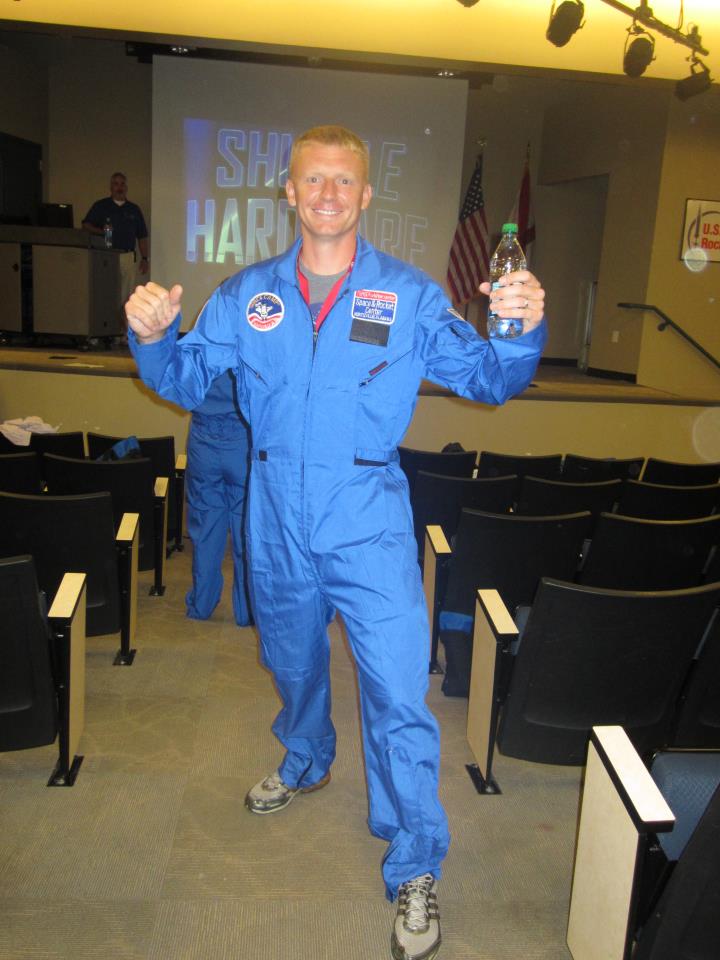
This week I am coming to you live from Huntsville, Alabama where I am privileged to be attending International Space Camp. Last night was our “opening ceremonies” where the teachers of the year from every state introduced themselves and their state while wearing some sort of costume to represent their state. We had New York dressed as the Statue of Liberty and the guy from Washington as a nearly fully functioning Mount St. Helens and 48 other costumes. After each state introduced themselves and presented, we had the great pleasure to listen to our international counterparts speak about their countries which was both highly informative as well as entertaining. My favorite was the German students who presented a couple abridged versions of Brothers Grimm fairy tales in hilarious fashion.


Beyond the pomp and circumstance of the opening ceremony we have also had the opportunity to listen to Astronaut Charlie Duke. He spoke to our group about his experiences in NASA and his Apollo 16 flight and subsequent walk on the Moon. Needless to say there is something surreal listening to a man talk about walking on the moon in the same manner I talk about walking to the ice cream shop. In addition to Duke, we had dinner with other members of NASA’s space program including some of the original designers and engineers that worked on the Saturn 5 which was directly overhead as we ate.

Today we begin our flight missions and presumably the real “fun” of Space Camp that many children have dreamed of participating in. As I being this week full of learning, challenges and surely a great deal of fun, I am reflecting on a comment made in our first session when we arrived here at Camp. The coordinator of the program was introducing Space Camp and the ideals of NASA and overall space exploration. While doing so she said, “we explore because it’s there.”

She didn’t say we explore because we have to. Nor did she say we explore because we are being asked to. Yes, you can argue that the engineers and astronauts were doing their work because it was their job and they did have someone telling them to do just that. However, at the very basic level, the exploration of space was out of a sense of wonder and amazement and probably a heavy dose of curiosity. When you listen to the people involved in the early years of NASA as we have this weekend, they truly loved what they did. They wanted to put man into outer space and did just that. They were creative problem solvers and critical thinkers because they had to be. What is more amazing is just what they were able to accomplish with the level of technology they had available. As Duke said, we have more technological power within an iPhone that he did on the entire Apollo 16 ship. That is staggering.

I plan on using the phrase “we explore because it’s there” in my classroom. I want my student to explore and discover because it’s there, not because it will be on the test or because it is in the curriculum map. I want them to learn because it’s there…period.